Get a Free Diagnosis for Your Property Project
Keep Driveway Drainage Moving With a Culvert Installation Service in Lubbock, TX
Maintain drainage beneath residential driveway crossings with careful excavation, pipe placement, proper slope, and compacted backfill.
Keep Water Moving Beneath Your Driveway
A residential driveway may need to cross a ditch or natural drainage path before reaching the rest of the property. Without an appropriate way for water to pass beneath that crossing, runoff can collect along the entrance, wash away surrounding material, or move across the driving surface. Culvert installation creates a defined route for water while maintaining vehicle access above it.
Hendrix DIRT WORKS provides culvert installation in Lubbock, TX, for residential properties where drainage and driveway access meet. We excavate along the existing ditch line, establish the required slope, position the culvert pipe, and carefully backfill and compact the surrounding material.
With over 17 years of combined experience, we understand how excavation, grading, drainage, and driveway preparation work together. We evaluate the crossing and surrounding terrain before beginning so the culvert is placed around the conditions of the property rather than treated as an isolated pipe installation.
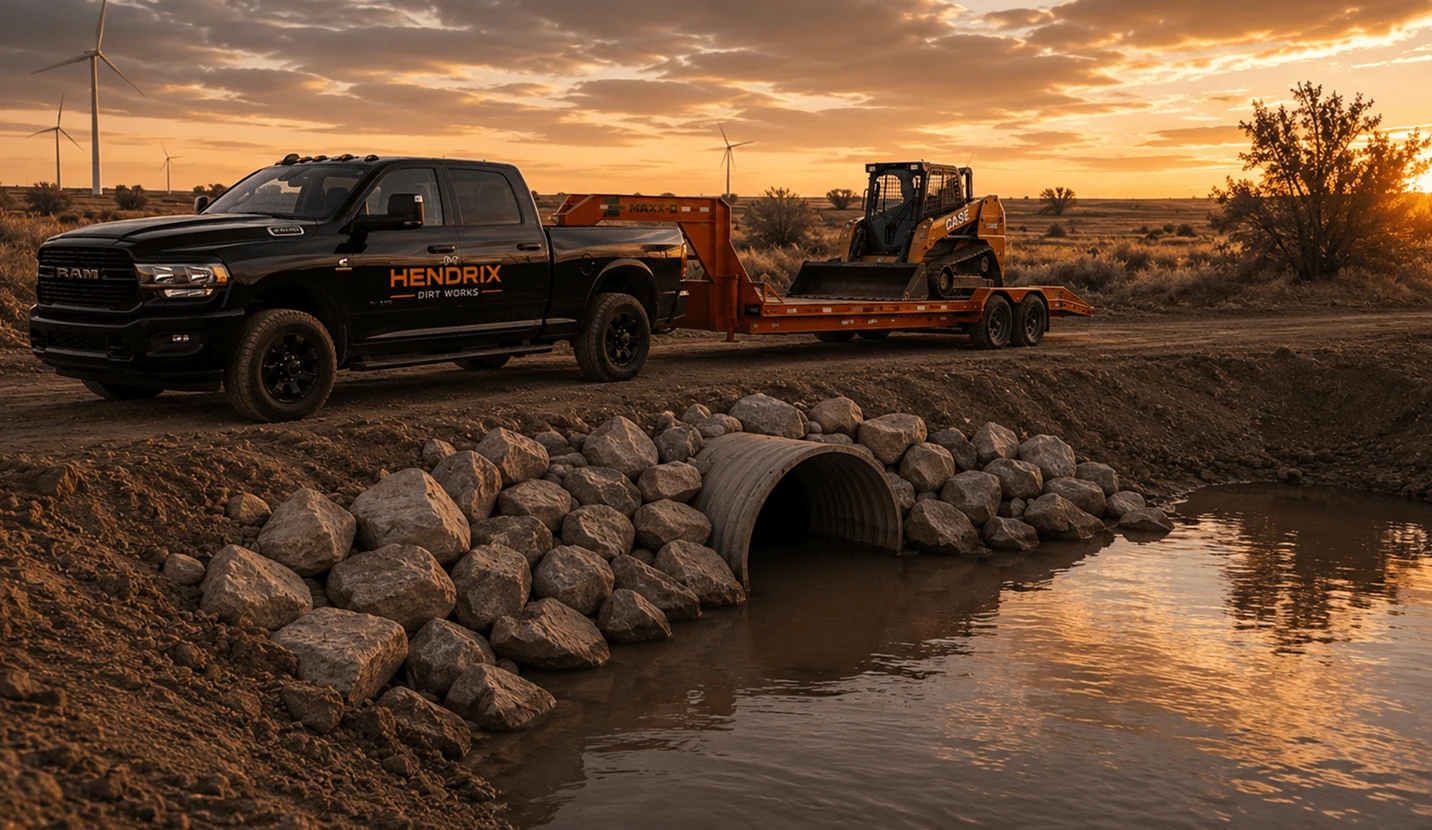
Create a Defined Drainage Path Beneath Residential Access
A culvert has two important jobs. It needs to allow water to continue moving through a drainage path, and it needs to support the driveway crossing above it. Meeting both needs starts with understanding the existing ditch line and how water approaches and leaves the crossing.
Our process begins with evaluating the planned installation area. We look at the existing drainage path, driveway location, surrounding elevations, and equipment access. These conditions help determine how excavation and pipe placement should proceed.
The ditch line is then excavated to prepare a suitable location for the culvert. Careful excavation establishes the path and elevation needed for pipe placement. A culvert positioned without consideration for the surrounding ditch can interfere with water movement rather than provide the intended route.
Slope is particularly important. Water needs to enter the pipe and continue toward the outlet, so the culvert should follow an appropriate drainage grade. Existing property elevations and the ditch profile help guide how the pipe is positioned.
Once the prepared route is established, the culvert pipe is placed within the excavation. Proper positioning helps align the inlet and outlet with the surrounding drainage path. Backfill is then placed around the pipe and compacted to create a firmer crossing area.
Our culvert installation process can include:
- Crossing assessment: We review the driveway location, ditch line, surrounding elevations, drainage direction, and equipment access.
- Ditch-line excavation: We prepare the crossing area so the pipe can be positioned within the existing drainage path.
- Drainage slope setup: We establish an appropriate grade to help water move through the culvert from inlet to outlet.
- Culvert pipe placement: We position the pipe according to the prepared route and surrounding property conditions.
- Compacted backfill: We place and compact material around the installed pipe to establish a firmer driveway crossing.
- Driveway crossing preparation: We shape the surrounding area so the culvert and residential access route work together.
Backfilling requires more than pushing loose soil over the installed pipe. Material needs to be placed around the culvert and compacted to establish a more stable crossing. This step also helps prepare the area for the driveway surface above.
The finished crossing should connect with the rest of the residential entrance. When the surrounding driveway also requires work, gravel driveway construction or resurfacing can address the driving surface. Grading may be needed to shape nearby ground and create smoother transitions into the crossing.
Culvert work can therefore be part of a larger access project rather than a stand-alone improvement. Looking at the driveway and drainage together helps create a more coordinated result.
Protect Driveway Access While Managing Runoff
Water can create recurring problems when it reaches a residential entrance without a clear route through or around it. Runoff may collect against the driveway, travel across the surface, or erode soil near the crossing. Repeated water movement can gradually affect the material surrounding the entrance.
A culvert provides a route beneath the driveway so the drainage path can continue without requiring water to travel directly across the driving surface. This can be particularly important where a roadside ditch or property drainage channel intersects with the entrance.
Culvert installation should account for more than the pipe itself. The inlet needs to receive water from the existing drainage route, while the outlet needs to allow that water to continue beyond the crossing. If surrounding elevations interfere with either side, additional grading may be needed to establish better transitions.
The driveway above the culvert also needs appropriate preparation. Compacted backfill helps establish the crossing before the final driving surface is completed. Depending on the property, gravel or other driveway material may then be placed as part of the entrance.
Hendrix DIRT WORKS can coordinate culvert installation with related residential groundwork. A new gravel driveway may require a culvert where the entrance crosses a ditch. An existing driveway may need drainage correction if runoff repeatedly affects the crossing. Dirt work and grading can reshape nearby ground when elevation changes are part of the problem.
Broader drainage conditions may also require additional work. A culvert is designed to carry water beneath a crossing, but it does not automatically correct every standing-water or runoff issue elsewhere on the property. Drainage solutions, French drains, or low-spot leveling may be more appropriate for other water problems.
We tailor the work to the property instead of assuming every crossing has the same requirements. Ditch dimensions, existing elevations, driveway conditions, drainage patterns, and access can vary significantly between residential sites.
We also welcome smaller projects. A single driveway culvert can have an important effect on residential access even though the project is focused on one area. Hendrix DIRT WORKS takes on these residential jobs along with larger excavation and property improvement projects.
We treat customers like family and communicate clearly about the work being performed. We are fully insured and bonded and bring over 17 years of combined experience to excavation, driveway, and drainage work. Our focus remains on careful preparation and customer satisfaction throughout the project.
Timing depends on the condition of the crossing, excavation requirements, pipe placement, backfill needs, surrounding grading, and equipment access. A straightforward crossing will have different requirements from an area where the ditch or driveway also needs substantial reshaping.
Project cost varies for the same reasons. We do not provide unsupported fixed pricing because each property has different excavation and drainage conditions. Free quotes are available so the crossing can be evaluated before work begins. Warranty options are also available and can be discussed according to the applicable project.
If your residential entrance crosses a ditch or drainage path, a properly installed culvert can help water continue beneath the driveway while preserving access above it. From excavation and slope setup to pipe placement and compacted backfill, we focus on creating a crossing that works with the surrounding property.
Culvert Installation FAQs
-
A culvert may be needed when a residential driveway crosses a ditch or drainage path. The pipe allows water to continue beneath the entrance rather than collecting against or flowing directly across the driving surface.
-
Proper slope helps water travel from the inlet through the pipe toward the outlet. The culvert route should work with the surrounding ditch and property elevations.
-
Material is backfilled around the installed pipe and compacted to establish a firmer crossing. The surrounding area can then be prepared to connect with the residential driveway.
-
Yes. Culvert installation can be coordinated with gravel driveway construction, driveway grading, resurfacing, or related dirt work when the crossing is part of a broader entrance project.
-
No. Culverts primarily carry water beneath crossings. Standing water or runoff elsewhere on the property may require grading, drainage solutions, French drains, or other ground correction.
Keep Water Moving Beneath Your Entrance
Establish a residential driveway crossing with careful culvert placement, drainage slope, compacted backfill, and surrounding ground preparation.